1. Overview of the French Real Estate Market
France real estate has long been considered one of the most stable and resilient markets in Europe. In particular, the historic buildings in Paris, the vacation villas on the French Riviera, and the residential areas in emerging cities like Lyon and Bordeaux all convey a sense of maturity and stability. This characteristic stems from France’s strict policy supervision, limited land supply, as well as deep cultural and asset preservation awareness.
It is also worth noting that the “hollowing out” and stagnation of housing prices in rural France contrast sharply with the above-mentioned areas. Even in major cities, market polarization has become increasingly evident, so it’s essential for buyers to conduct thorough research on specific areas according to their own goals and budget.
2. Stability: The Stabilizing Force of the European Real Estate Market
Data Source: insee.fr
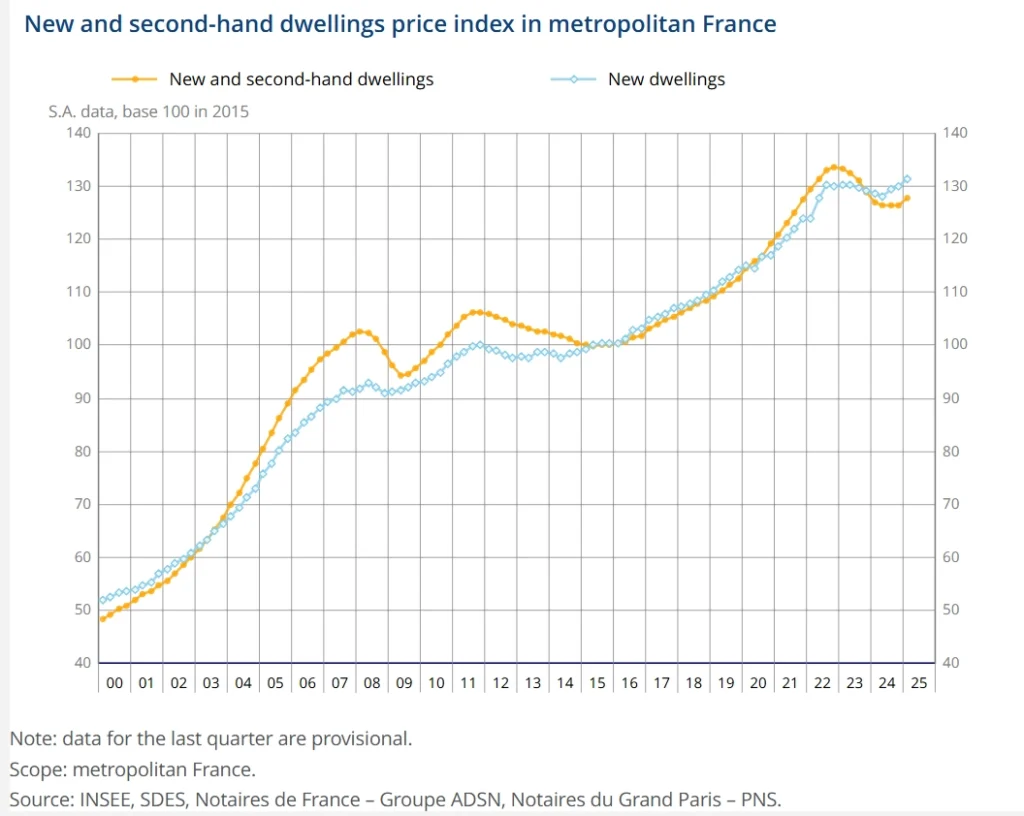
According to data from the French National Institute of Statistics and Economic Studies (INSEE), housing prices in France have generally followed an upward trend over the past few decades. Although prices experienced a brief correction between 2022 and 2024 due to rising interest rates, they returned to growth in 2025. Even during the 2008 financial crisis, when French property prices declined, they quickly bottomed out in 2009 and surged to a new record high by 2010, surpassing its pre-crisis peak. These data reflects the stability of French real estate. Below we analyze the reasons for the formation of this characteristic.
3. Scarcity: Land Restrictions and Cultural Preservation
The French government has extremely strict control over urban construction and land development.
1) The land for new residential buildings is extremely limited
Under France’s “No Net Artificialisation” goal and its mid-term quantitative targets, the national land consumption rate must be halved between 2021 and 2031. This means that, compared to the average annual consumption of approximately 20,000 to 30,000 hectares of land between 2011 and 2020, future annual newly developed land will be strictly limited to around 10,000 hectares or even less.
2) The demolition of old buildings is subject to protection regulations
France has established an efficient heritage conservation system based on three pillars: mandatory approvals, economic incentives, and specialized expertise. Building on this framework, the “urban mending” philosophy is now being promoted, focusing on creative adaptive reuse to revitalize and ensure the sustainable development of heritage assets.
3) The height and exterior design must comply with historical preservation standards
In protected historic areas, any new construction, renovation, or restoration work must ensure that the building’s massing, height, facade design, materials, and even color schemes integrate harmoniously with the surrounding historic environment. The primary goal is to preserve the visual integrity of the heritage.
4) Emphasize the concept of “livable city”
France does not blindly pursue urban expansion but places a strong emphasis on transportation convenience, public spaces, and quality of life. As a result, residential areas are typically well-planned and benefit from a stable community atmosphere.
Although these policies suppress supply, they also ensure the uniqueness and scarcity of properties, making them more valuable.
4. Strict Regulation and Restrictions on Speculation
1) Property Purchase Regulations
- In France, real estate transactions must be completed through a notary, and the fees account for 2%-3% of the total price. The notary ensures the legality and validity of the transaction, and is responsible for calculating and collecting the applicable taxes.
- When purchasing a property with a mortgage, non-residents face more stringent scrutiny, including checks on their professional background and income verification, and are required to make a down payment of at least 30% to 40%.
- The seller is legally required to provide a series of mandatory documents, including land registry information, urban planning documents, an energy performance certificate, and technical diagnostic reports for termites, asbestos, lead, gas, and electrical installations.
2) Property Tax System
| Tax Types | Taxation Stage | Key Rules | Tax Rate |
| Notary Fees/Registration Tax | Purchase | When buying a new home, the cost is only the notary fee. When buying an existing home, most of the tax is the registration tax. | Existing properties: 7%–8% of the total price (including notary fee) New properties: 2%–3% of the total price |
| Property Holding Tax | Pay annually | Property owner pays | Approximately 0.2–1.2% of the house price |
| Capital Gains Tax | Capital Gain Event | Principal residence: completely exempt. Non-primary residence: After 22 years of ownership, the social surtax can be exempted; after 30 years, the capital gains tax can be fully exempted. | 19% on the net gain + 17.2% in social surcharges = a total of 36.2% |
3) Rental Protection System
- France’s rental laws are extremely comprehensive and tenants enjoy a high degree of protection. For example, a landlord simply cannot raise the rent or end the lease early without cause. Meanwhile, tenants have the right to renew their lease, and the landlord must have a valid legal reason to refuse. This policy ensures the long-term stability of the rental market.
Although these French procedures and regulations are stringent, they effectively guarantee transactional security and significantly raise the barrier for speculation, thereby playing a vital role in stabilizing the real estate market.
5. The Value Logic of French Real Estate
For international investors, the greatest appeal of French real estate lies not in short-term speculation, but in asset security and stable cash flow.
Although the average rental yield in France is only 4.63% (as of Q2 2025), the government’s development of high-quality communities and a well-regulated rental market provides investors with a highly reliable source of passive income.
At the same time, the capital security of French real estate is generally high, especially in core areas such as the 6th and 7th arrondissements of Paris and the French Riviera. Investing in these areas serves not only as an effective means of asset preservation, but also as a long-term strategy to hedge against global inflation and achieve wealth appreciation.
It is noteworthy that the French government is implementing stricter energy efficiency standards (RE2020), which will gradually phase out the rental and sale of non-compliant older properties. This is spurring a wave of renovations and creating new investment opportunities.

6. Summary
The French real estate market can be characterized by three key features: stability, scarcity, and sustainability. These attributes give it a unique position in global asset allocation. For buyers seeking durable, secure, and stable investment targets in the global market, France Real Estate represents a highly worthwhile option to consider.
Related Reading