As an emerging market in Southeast Asia, Indonesia real estate has become a popular destination for passive income investment due to its rapidly growing tourism economy, relaxed foreign investment policies, and rising middle class.
1. What is Passive Income Investing?
Passive income is income that you receive regularly without having to invest a lot of time and energy. Unlike traditional “active income,” such as salary, it allows money to work for you, thus achieving financial freedom and time freedom. In real estate, passive income typically comes from rental income, property appreciation, real estate investment trusts, etc.
2. The Difference Between Passive and Active Income
| Comparison Dimensions | Passive Income | Active Income |
| Time Investment | Requires some initial investment, but ongoing management costs are low | Requires long working hours |
| Income Stability | Long-term stability | May fluctuate |
| Wealth Accumulation | Asset appreciation and cash flow | Primarily relies on salary or business profits |
| Typical Examples | Rent, dividends, royalties, REITs | Salary, freelance income, and business operations |
Advantages of passive income:
- Time freedom: No need to work at a fixed time or place, relatively free time.
- Risk resilience: Diversifying income sources can reduce the impact of economic fluctuations.
- Compounding effect: Early investment requires a certain amount of investment. Once the returns stabilize, assets can snowball.
3. Three Main Forms of Passive Income From Indonesia Real Estate
- 1. Rental income
The most common way to obtain passive income is to obtain monthly cash flow through renting out properties.
Long-term rental: Long-term rental is more suitable for families or office workers and has high stability. For example, apartments in the capital, Jakarta.
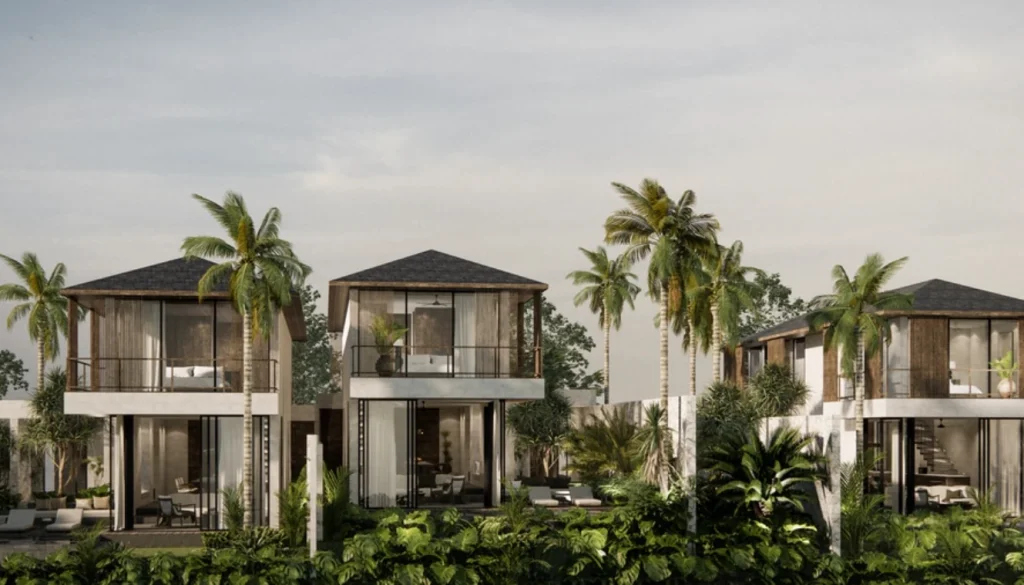
Short-term rental: Short-term rental is very popular in tourist cities. However, the returns are higher, but the management is complicated, such as villas in the tourist resort of Bali.
Reference for Indonesian rental return rate:
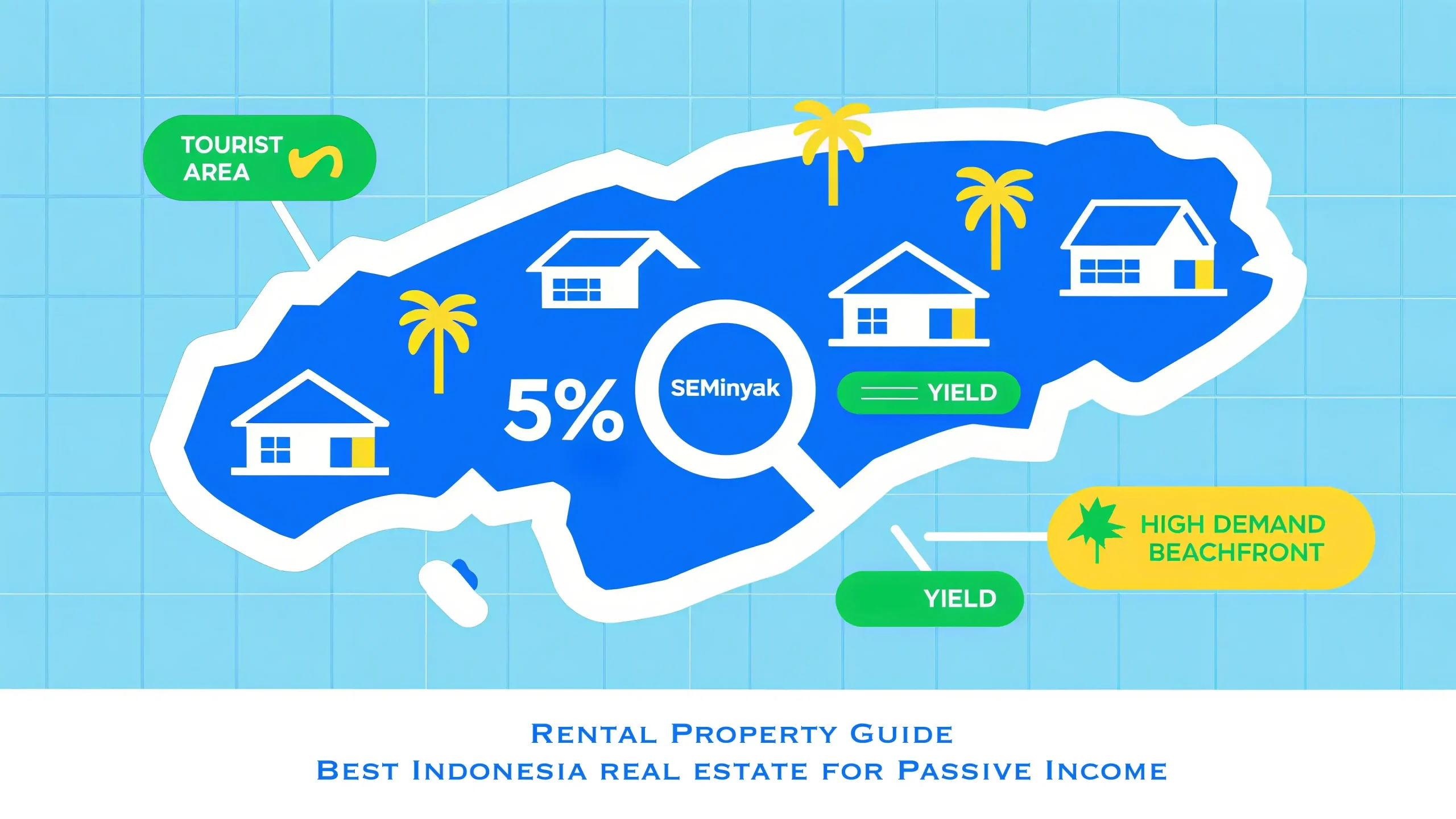
Bali villas: The average annual return on investment can reach 5% or even 8%.
Jakarta apartments: The average annual return on investment can reach 4-6%.

Low-cost properties in Yogyakarta: Due to the low cost of purchasing a property, the average annual rental return can reach 6-9%.
- 2. Capital Appreciation
Buyers and investors buy properties with good locations and potential for appreciation early on. Wait for the market to appreciate and then sell them for profit. Indonesia’s popular areas for value-added:
Bali’s Canggu and Uluwatu: Driven by digital nomads and tourists, it has become a world tourist destination, so there is great room for property appreciation
Jakarta’s SCBD and Thamrin: This area is a commercial center, so housing prices are highly resistant to declines.
New Capital Nusantara: The long-term policy dividends of the new capital have given the local real estate great room for appreciation.
- 3. Real Estate Investment Trusts (REITs)
Buyers and investors indirectly invest in real estate by purchasing REITs shares. They can enjoy dividends without having to manage the property.
Examples of Indonesian REITs:
PWON Property (retail and office properties).
BSDE Bumi Serpong Damai (residential and commercial development).
4. Why Choose Indonesia for Passive Income Investment?
- 1. Strong tourism economy and strong demand for short-term rentals
Bali, Lombok, and other places in Indonesia attract countless tourists from all over the world every year. The occupancy rate of Airbnb homestays remains high year-round.
- 2. Gradually opening up foreign investment policies
The government allows foreigners to purchase apartments and lease land. This policy has attracted a large number of foreign investors. Digital nomad visas (such as B211A) attract long-term tenants.
- 3. Demographic dividend and urbanization
The number of middle-class people in Indonesia is expected to reach 135 million by 2030, which has greatly boosted the demand for housing. The continuous development of urbanization has also caused the average annual increase of 3-5% in housing prices in cities such as Jakarta and Surabaya.
| Indonesia’s GDP | Data from the World Bank |
| GDP in 2024 | $1.396 trillion |
| GDP growth rate | 5.03% |
| Domestic GDP per capita | $4,960 |
| Population | 283.5 million |
| Number of tourists | 13.9 million (An increase of 19.05% compared to 2023) |
According to statistics from the Indonesian Central Bureau of Statistics, the 2024 residential property price index shows that new property prices, in this case including houses and apartments, in March 2024 increased by 2.76% compared to March 2023, where house prices increased by 2.97%, while apartment prices fell by 1.03%. The increase in property prices slowed slightly compared to the increase in property prices in 2023.
Meanwhile, property prices have increased by 10.90% from 2019, which was before COVID-19. The increase in house prices in the 4-year period was 11.19%, and the increase in apartment prices was 5.52%.
The increase in property prices is due to several factors, such as the high demand for housing, the increase in land prices, and the increase in building material prices.
5. How to Invest in Passive Income Properties in the Indonesia Real Estate Market?
Step 1: Clarify your goal
First, clarify your investment objectives. For example, if cash flow is your primary concern, choose high-return areas like Yogyakarta and Bandung. If long-term appreciation is your primary concern, consider investing in prime locations in Bali and Jakarta.
Step 2: Choose the right property type
| Property Type | Suitable for | Advantages | Risks |
| Bali Villas | Short-term rental for investors/holiday homeowners | High rental returns (5-10%) | High management costs and dependence on tourism |
| Jakarta apartments | Long-term or conservative investors | Large stable tenant base | Slow appreciation and high maintenance costs |
| Residential properties in second- and third-tier cities | Low-cost entry-level investors | Low prices, high rental returns of 6-9% | Low liquidity |
Step 3: Calculate ROI
This is the calculation formula: Net rental return = (annual rental income – annual expenses) / total purchase cost × 100%
For example, an investor purchases a villa in Bali. The villa is valued at $300,000. Renting it out would generate $24,000 in annual rent. However, the investor would also have to pay an additional $6,000 in management fees and maintenance costs. Using the above formula, we can calculate the return on investment for this villa to be (24,000 – 6,000) / 300,000 × 100% = 6%.
Step 4: Choose the right management method.
Self-management: Suitable for those living in Indonesia, it reduces costs but is time-consuming.
Entrusting a rental company: Landlords pay a 10-20% management fee of the rent. This reduces net returns but provides peace of mind.
6. Risks and Mitigation Strategies
Policy Risk: Foreign investment regulations may change.
Strategy: Consult a professional attorney and choose a freehold apartment.
Vacancy Risk: Properties in tourist areas are often fully booked during peak season but vacant during off-season.
Strategy: Diversify your tenant base (a mix of long-term and short-term rentals).
Exchange Rate Fluctuations: A depreciating Indonesian Rupiah (IDR) may impact returns.
Strategy: Settle some of your rent in US dollars.
Conclusion
As a passive income investment destination, Indonesia real estate is more suitable for investors seeking long-term, stable returns. Investing in real estate in core tourist areas can yield annual rental returns of 5-8% and the potential for asset appreciation. However, real estate investment often carries both rewards and risks. This requires investors to conduct sufficient market research and possess sufficient risk tolerance before investing.
👉 [Get in touch with our investment team]
👉 [Read More Property Insights]:
1. Why the Japanese Real Estate Market is a Safe Haven for Global Investors
2. Best Condos in Singapore Real Estate 2025: Top Picks for Investors